
Perhaps you'd just like to make a little extra money on the side. Perhaps you're thinking about building something that could eventually replace your job. Or perhaps you have much bigger business ambitions.
Whatever your goal, you've got an idea. The question is how to turn it into something real.
For many people, affiliate marketing is an attractive place to start.
Some people look down on affiliate marketing, often because they don't really understand what it involves. But think of it this way: a large department store sells products made by other companies. It brings those products to customers and earns money from the sales.
Affiliate marketing works on a similar principle. You introduce people to products or services offered by other businesses, and when someone makes a qualifying purchase through your referral, you may earn a commission.
You don't have to manufacture the product yourself. But you do have to find the right people, understand what they need and give them a reason to trust your recommendation.
So, where do you begin?
You might decide that building a website is the answer. You choose a name, find some hosting, create your pages and spend hours getting everything looking just right.
Eventually, you stand back and admire what you've created.
It's your jewel. And you're convinced that once people see it, they'll want to visit.
But there's a problem.
Your jewel is hidden.
Nobody knows it's there.
And that's when you discover one of the biggest challenges in building an online business:
How do you get people to your website?
You can pay to attract visitors through advertising. Or you can try to earn their attention through useful content, conversations, search engines and recommendations.
Paid traffic can bring visitors quickly, but the traffic you're buying generally stops when you stop paying.
Organic traffic takes a different approach. It gives you the opportunity to build relationships, establish trust and create content that people may continue discovering over time.
Of course, organic traffic isn't really free. It costs time, effort and patience. And there's no guarantee that it will work.
This isn't a problem I've encountered for the first time. I've been here before.
I've built websites, worked through training programmes and received guidance from experienced affiliate marketers, including John Thornhill.
John Thornhill with his ClickBank Platinum awards — 2020 - 2026.
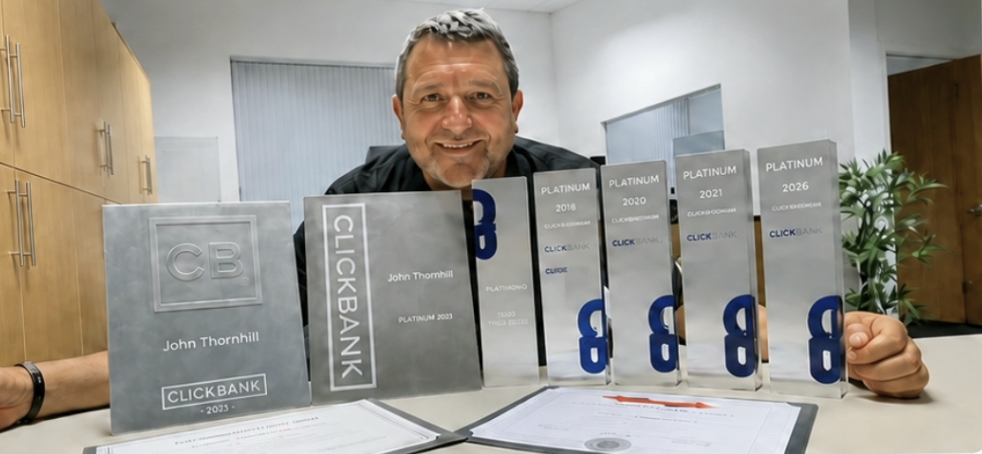
I learned how to build a website, choose products and put the foundations of an online business in place.
But sooner or later, I kept arriving at the same instruction:
That sounded sensible enough. But what exactly was free traffic? Where was I supposed to find it? What was I looking for? And how was I supposed to get people to visit a website they'd never heard of?
The answer was usually some variation of: Get involved in social media.
But what if you aren't an active social-media user? What if you don't have an established audience or thousands of followers? Where do you begin?
That was the brick wall I kept hitting.
I could build the website. I understood the business model. But I couldn't see a clear, practical route from having a website to finding people who might actually want to visit it.
And I began to suspect I wasn't the only person struggling with this.
There was plenty of advice about building an online business, and plenty of advice telling people they needed traffic.
Rather than keep collecting advice and hoping something would eventually work, I decided to investigate the problem for myself.
I would look for people who might be interested in what I had to offer, find out where they spent their time and discover what questions they were asking.
Then I would test whether useful content and genuine conversations could attract visitors to my website without paying for advertising.
I would record what I tried, what happened, what didn't work and what I learned along the way.
But before I could begin, I needed a way to think about finding those people.
And that brought me to a simple analogy.
Finding customers for an online business is rather like going fishing.
You know there are fish in the river, the lake or the sea. But knowing they're there doesn't mean you'll catch any.
An experienced angler doesn't simply arrive at the water, cast a line and hope for the best.
First, they find out what species of fish are likely to be there. They learn where those fish tend to gather, what they feed on and when they're most active.
Then they choose their equipment, their bait and the place where they'll fish. They consider the conditions and adjust their approach.
Even with all that preparation, success isn't guaranteed. But they're giving themselves a much better chance than someone who simply casts a line at random.
Finding an audience for an online business isn't so different.
We know there are people out there who might be interested in what we have to offer. But who are they? Where do they spend their time? What problems are they trying to solve? And what would make them stop and pay attention to us?
Those are the questions we need to answer before we start promoting anything.
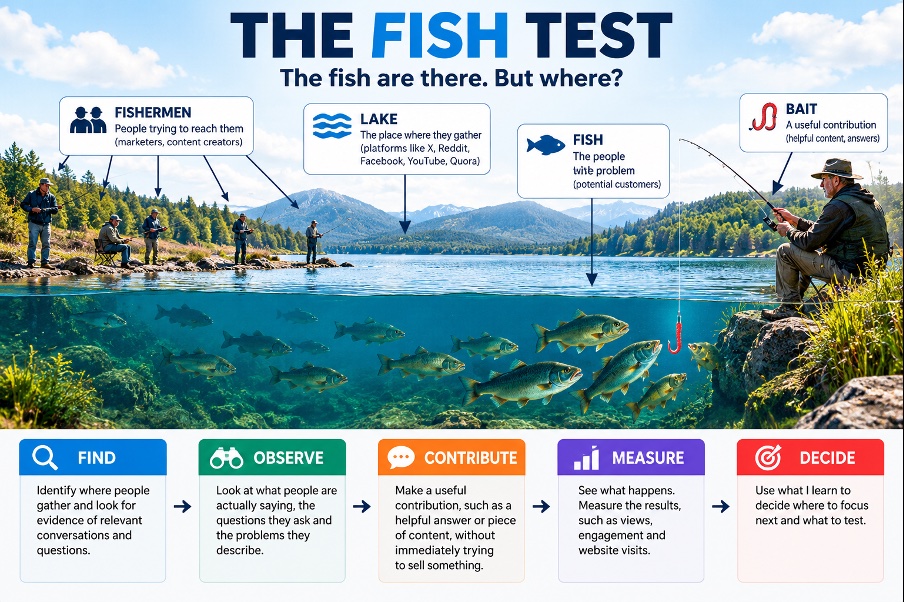
Our content needs to be relevant and attractive to the people we're trying to reach. Our website is somewhere they can learn more. And our offer needs to be a genuine match for what they're looking for.
But unlike fishing, we're not trying to catch someone who doesn't want to be caught. We're trying to start conversations, earn trust and help people make decisions that are right for them.
The aim isn't simply to attract more visitors. It's to attract the right visitors.
That's the thinking behind my free-traffic experiment.
I'm investigating where potential customers spend their time, what questions they're asking and what kind of content gets their attention.
Then I'll test different approaches, measure what happens and use the results to decide what to do next.
Because before we worry about how many fish we can catch, we need to find out where they're swimming.
I decided to start by looking for people interested in making money online.
Rather than immediately promoting products, I wanted to discover where those people spent their time, what questions they were asking and whether there were opportunities to join useful conversations.
I began investigating five platforms: X (Twitter), Quora, Reddit, Facebook and YouTube.
Each platform has its own communities, ways of discovering content and opportunities to reach people. But having millions of users doesn't necessarily mean it's the right place to find an audience for my business.
So I'm testing them, one by one.
I'm recording what I try, what happens and what I learn. Some approaches may work. Others may produce very little. Either way, the results will help me decide where to concentrate my efforts.
The experiment isn't about proving that free traffic works. It's about finding out whether I can make it work — and what it actually takes.
Before trying to attract visitors, I needed to understand who I was looking for. My research revealed three very different groups of people, each with different needs and starting points.
© 2026 Ian Ashbrook. All Rights Reserved.